
Summary
Retrospective planning permission is when you apply for planning approval after building works or a change of use have already taken place without consent. It is assessed against the same planning policies as any normal application, but it carries significantly higher risk because refusal can lead directly to enforcement action, including alteration or demolition. What most articles fail to explain is that retrospective planning is not just about rules – it is about judgement, timing, credibility, and whether the planning harm is already fixed.
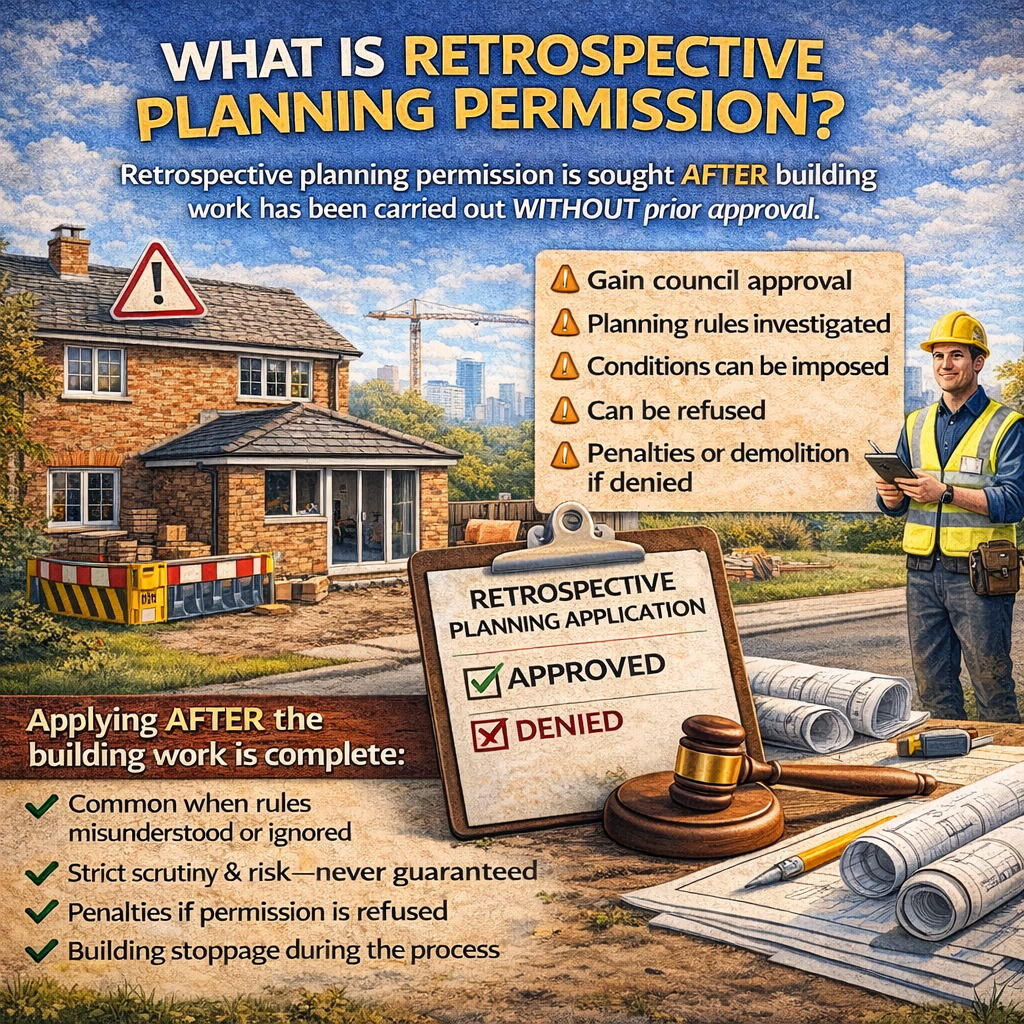
Retrospective planning permission is the process of asking a local planning authority to approve development that has already been carried out. This might include extensions, garages, dormers, outbuildings, internal or external alterations, or a material change of use that should have required permission before works began.
The development already exists. The council is not being asked to assess a proposal in principle, but to decide whether what is physically there should be allowed to remain. That distinction is critical and is often glossed over in generic guidance.
Retrospective planning is not a different type of permission and it is not assessed more leniently. The same development plan policies, design guidance and material considerations apply. In practice, scrutiny is often more intense because impacts on neighbours, streetscape and amenity are no longer theoretical.
Yes. UK planning law explicitly allows retrospective planning applications. A council cannot refuse an application solely because development has already taken place. However, this legal allowance is frequently misunderstood. The ability to apply retrospectively does not protect the development, and it does not increase the likelihood of approval. The application can be refused for any normal planning reason, exactly as if it had been submitted in advance. This is where many homeowners and developers get caught out. Lawful to apply does not mean safe to rely on.
Most retrospective applications are not the result of deliberate planning avoidance. They typically arise because permitted development rights were misunderstood, because works evolved on site beyond what was approved, or because a change of use was assumed to be acceptable without consent. In many cases, the issue only comes to light after a neighbour complaint, an enforcement investigation, or a solicitor identifies a problem during a property sale or refinance. By that stage, the planning question has fundamentally changed. The council is no longer considering what might be acceptable, but whether the harm created by what already exists can be justified.
On paper, the assessment framework is the same. In reality, the consequences are not. When a normal planning application is refused, nothing has been built. The outcome is redesign, delay, or abandonment. When a retrospective application is refused, the refusal has teeth. It can trigger enforcement action requiring physical alteration, removal, or complete demolition of the development. This is why retrospective planning should never be treated as a strategy. It is a remedial process, not a fallback position.
A retrospective application submitted proactively, before any complaint or investigation, is fundamentally different from one submitted after an enforcement case has been opened. Once enforcement officers are involved, the council is not only assessing planning harm. It is also considering precedent, public confidence and procedural integrity. That context, while rarely written down, can heavily influence outcomes. Planning does not operate in a vacuum, and retrospective applications are not assessed in isolation from how and why they arose.
Generic articles tend to treat retrospective planning as a single category. In practice, councils instinctively place cases along a spectrum of harm. At one end are minor, technical deviations where impacts are limited and defensible. At the other are developments that introduce clear, lasting harm to neighbours, character or policy objectives. Once a scheme falls into the latter category, no amount of procedural correctness will save it. This explains why two retrospective applications that look similar on paper can have completely different outcomes.
We were contacted by a client following a neighbour complaint about a garage that had not been built in accordance with approved planning drawings prepared by another architect. Although permission existed for a garage, what had been constructed read visually as a granny annexe, with windows and a door that fundamentally changed how the building was perceived. This was not a minor deviation. The issue went to the heart of use, character and policy compliance. Through a carefully curated and deliberately restrained strategy, the proposal was reframed to address the council’s real concerns rather than attempting to excuse what had been built. The planning justification focused on perception, policy alignment and impact, and retrospective planning permission was ultimately granted. The success of that application had nothing to do with luck. It was about judgement and credibility.
In another case, a client constructed a rear dormer without planning permission. A neighbour complaint triggered council involvement, and an enforcement notice was issued. We were instructed to submit a retrospective application, followed by an appeal after refusal. Both failed. The reason was not poor paperwork or weak presentation. The dormer introduced planning harm in terms of scale, massing and neighbour impact that could not be undone through argument. Once built, the harm was visible and measurable. The planning balance fell decisively against the development, and enforcement action stood. This is the reality many online guides avoid confronting.
A persistent misconception repeated online is that councils are reluctant to refuse retrospective applications because demolition is “extreme”. This is simply untrue. Councils refuse retrospective applications regularly, and enforcement requiring removal or alteration is not unusual where harm is identified. The existence of the development does not soften policy conflict. In many cases, it sharpens it. Assuming that “they won’t make you take it down” is one of the most expensive mistakes people make in planning.
Many experienced architects and planning consultants are cautious about taking on complex retrospective work. Where a scheme is not the product of considered planning judgement from the outset, there are real limits to how far it can be defended. Design decisions that cause harm cannot be retroactively redesigned on paper. They can only be explained, and explanation does not neutralise impact. There is also a human dimension. It is genuinely difficult to see clients invest significant sums into work that may ultimately have to be altered or removed, when that risk could have been avoided by seeking advice earlier.
This is the wrong question, and it is the framing most online articles rely on. The better question is whether the development would have had a realistic chance of approval if it had been properly designed and assessed before construction. If the honest answer is no, retrospective planning is not a calculated risk. It is damage limitation with poor odds. Planning works best when it informs design, not when it is asked to justify it after the fact.
Retrospective planning permission exists to resolve mistakes, not to legitimise avoidable ones. Sometimes it works. Sometimes it fails. What determines the outcome is not the application form, but whether the development can genuinely be defended against planning policy now that it exists. Most articles explain what retrospective planning is. Very few explain why it fails, why enforcement context matters, or why experienced professionals approach it with caution. Understanding that difference is what separates generic advice from real planning insight – and it is often the difference between resolution and regret.
