
Summary
Permitted development is a set of national planning rules in England that let homeowners carry out certain projects without full planning permission. This includes single storey rear extensions, loft conversions with rear dormers, modest side extensions, porches, and outbuildings, as long as strict conditions are met. Rights vary by property type, planning history, and location, and some work may still require council approval or a Lawful Development Certificate.
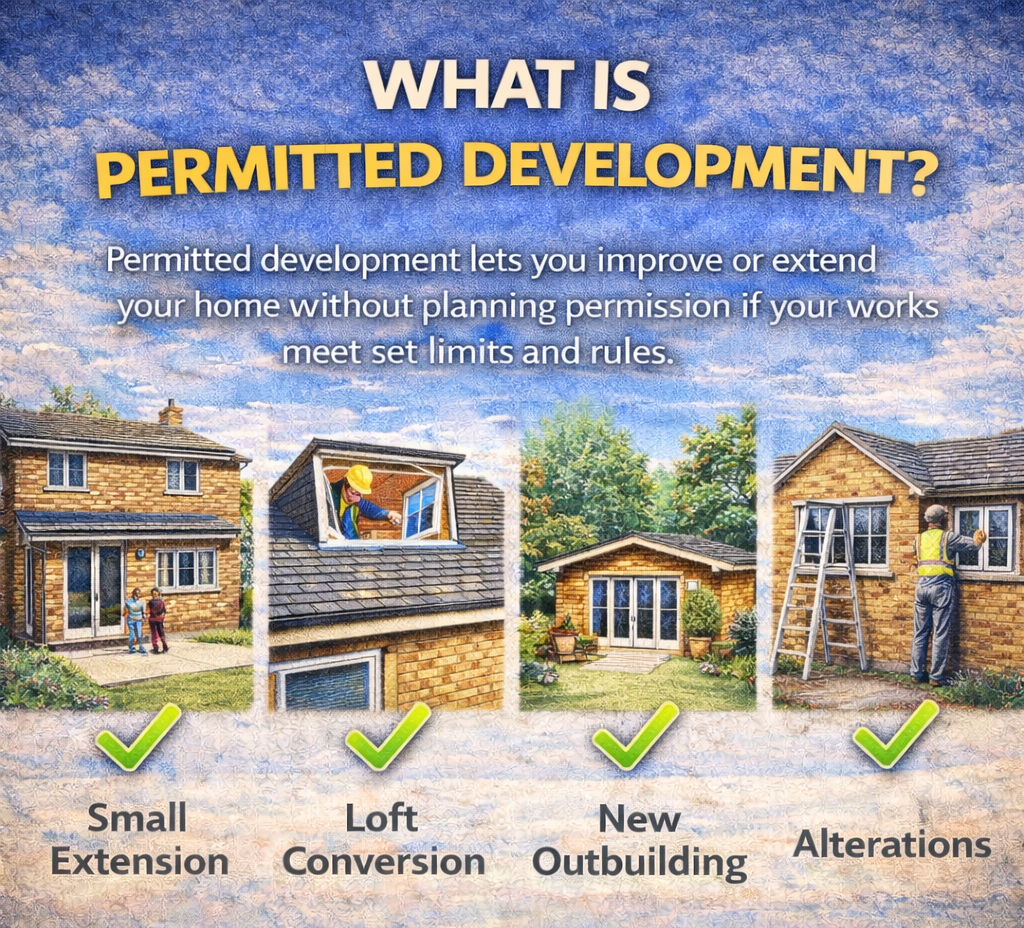
Before we dive into details, here’s an at-a-glance guide to the most common projects and their limits. This helps homeowners check eligibility quickly.
|
Project |
Key Limits |
Notes |
|
Rear extension (single storey) |
Detached: 4m, Other houses: 3m; max height 4m; within 2m of boundary eaves max 3m |
Prior approval required for larger extensions (8m/6m) outside designated land |
|
Side extension |
Single storey, width ≤ ½ original house, height ≤ 4m |
Upper-floor side windows must be obscure-glazed; not allowed on designated land without permission |
|
Porch |
Ground area ≤ 3m², height ≤ 3m, ≥ 2m from boundary if facing highway |
Even small porches must comply |
|
Loft conversion / dormer |
Volume ≤ 40m³ (terraced) / 50m³ (detached/semi); height ≤ existing roof; set back ≥ 20cm from eaves |
Front dormer facing highway not allowed; side windows obscure-glazed; check for bats |
These are high-level limits. Full compliance depends on property history, design, and local restrictions. Always double-check before starting work.
Permitted development is pre-approved planning permission at a national level. You don’t submit a standard planning application, but your project must comply exactly with the rules in the General Permitted Development Order. There’s no flexibility: if you exceed the limits, even slightly, your project could be unlawful. Permitted development exists to allow small-scale, low-impact changes without overloading councils, but it’s measured with precision.
Rear extensions are the most frequent permitted development project. For detached houses, single-storey rear extensions must not extend more than 4 metres from the original rear wall, while for semi-detached or terraced houses the limit is 3 metres. Maximum height is 4 metres, and if the extension sits within two metres of a boundary, the eaves cannot exceed 3 metres. Materials should match the existing house, and roof pitches should complement the original roof.
Single-storey side extensions can be permitted development, but the rules are tighter. Width cannot exceed half the width of the original house, and height is capped at 4 metres. On designated land like conservation areas, side extensions will require planning permission. These rules explain why side extensions often need professional guidance.
Yes, under strict conditions. The ground area must not exceed 3 square metres, the height cannot exceed 3 metres, and porches fronting a highway must sit at least 2 metres from the boundary. Even small porches must comply to be lawful under permitted development rules.
Loft conversions, also called roof extensions, can be permitted development if your house is not on designated land. Volume limits are 40 cubic metres for terraced houses and 50 cubic metres for detached and semi-detached houses, including previous roof additions. Extensions cannot project beyond the plane of the roof facing a highway. Materials must match the house, and height cannot exceed the highest point of the existing roof. Balconies, verandas, or raised platforms are not allowed. Side windows must be obscure-glazed, and roof extensions must be set back at least 20 centimetres from the original eaves. Work must also consider protected species like bats; surveys or licenses may be needed.
Permitted development rights do not automatically apply in conservation areas, Article 4 Directions, or where planning conditions remove them. Flats and maisonettes do not benefit from permitted development rights at all. Previous extensions also reduce your available allowance, making it critical to check planning history before starting any work.
Even when no application is submitted, councils can assess work retrospectively. Complaints, enforcement investigations, or property sales often trigger this review. Councils check compliance exactly against the legislation, so minor deviations can make a development unlawful. Experienced designers treat permitted development as a constraint, not a free pass.
A Lawful Development Certificate confirms that your project is lawful under permitted development rules. While optional, it provides legal certainty, making it easier to sell or refinance a property and reducing the risk of enforcement action. Permitted development is a powerful tool for homeowners, but it is not a loophole. Success depends on exact measurement, careful design, property history, and professional guidance. If in doubt, get in touch with us to discuss your proposal
