
Summary
Yes, Terraces and semi-detached houses can extend 3 metres, detached houses 4 metres. Design, neighbour impact, and functional space still decide whether it works in practice.
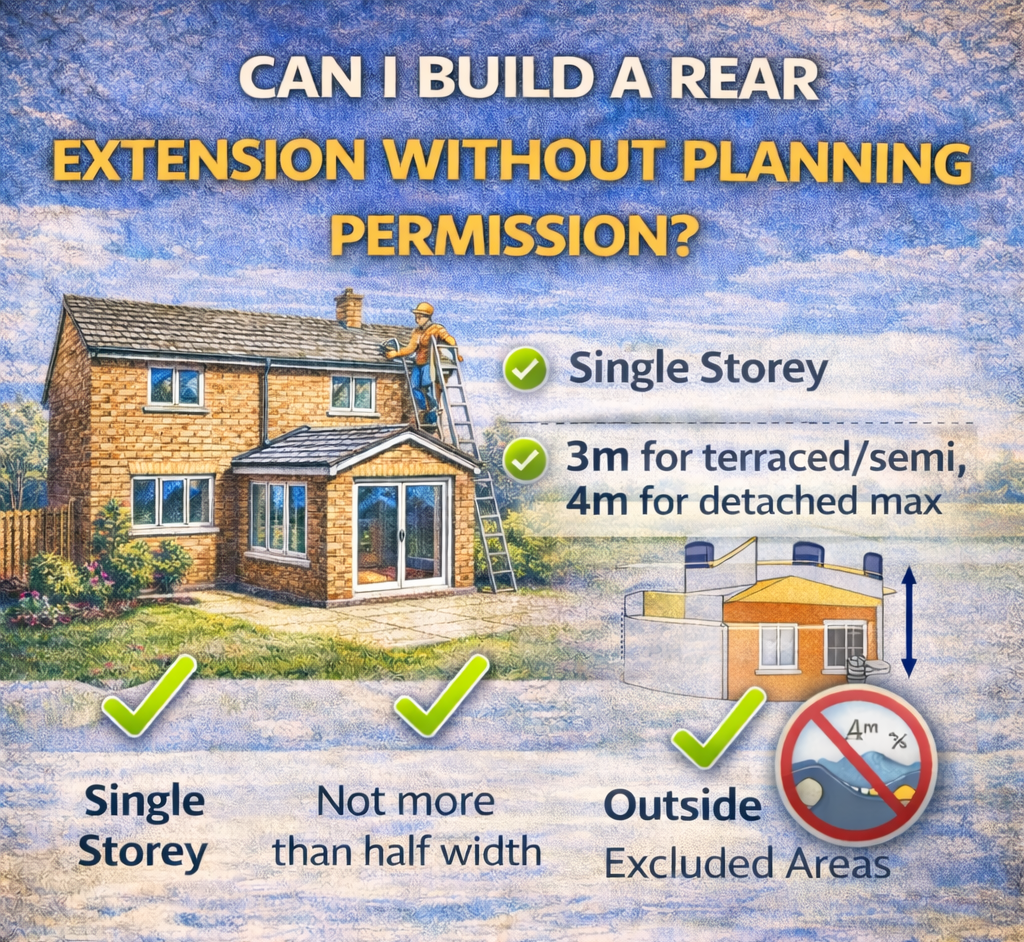
When homeowners ask whether they can build a rear extension without planning permission, what they’re really asking is whether they can extend without delays, objections, or unnecessary cost. Permitted Development (PD) is often seen as a shortcut, but in reality, it only works if the extension is modest, proportionate, and carefully designed. Rear extensions are extremely common, but they are also where PD is most frequently misunderstood. Many homeowners focus on the headline measurements without appreciating how councils apply judgement or how much usable space these measurements actually create inside the house.
Permitted Development rights allow certain house extensions without a full planning application. The principle is that small, predictable changes rarely cause harm. What PD does not do is remove planning judgement. Councils can intervene if an extension feels oppressive, blocks light, or dominates a neighbour’s garden, even if it technically meets size limits. This is why PD is not a loophole. It is a controlled framework that works best when extensions are restrained and sensitive to context.
The most widely cited PD limits relate to how far an extension can project. For terraced and semi-detached houses, the standard single-storey rear extension allowance is 3 metres. For detached houses, it is 4 metres. Under the larger home extension scheme, these increase to 6 metres for terraces/semi and 8 metres for detached houses, but this route requires prior approval and carries more risk of refusal.
Even when extensions meet these limits, homeowners often underestimate how much internal space they create. Take a 3-metre PD extension on a terrace or semi. With standard wall thickness of around 300mm, the usable internal depth is only about 2.7 metres, which is minimal for a functional living space, dining area, or kitchen.
For this reason, we often advise clients to apply for planning permission for slightly more than they initially want. This provides flexibility during design, avoids cramped interiors, and ensures the extension is fully functional once built. The reverse does not work: you cannot build something slightly larger than what PD allows, nor exceed what has been approved under planning permission.
Height matters as much as depth. Most single-storey rear extensions must not exceed 4 metres, dropping to 3 metres when close to a boundary. These limits control bulk and overshadowing, but they also affect perception. Even within limits, a full-width extension built tight to a boundary can feel overbearing to neighbours. Councils are sensitive to how an extension feels in real life, not just how it measures on a drawing.
The larger home extension scheme allows deeper extensions but introduces a prior approval process. Councils assess neighbour impact, focusing on loss of light, outlook, and overbearing effect. Neighbours are consulted, and objections can lead to refusal even if the extension technically complies with PD limits.
In practice, a 6-metre rear extension on a wide detached plot rarely causes complaints. The same depth on a narrow terrace, built hard against boundaries, is precisely where refusals happen. This demonstrates that PD is about judgement, context, and perception, not just numbers.
Many homeowners are surprised when extensions that meet PD measurements are refused. This happens because PD is often treated as a checklist rather than a judgement exercise. Councils intervene when extensions dominate gardens, block light, or materially affect neighbouring properties. These are the most common reasons PD rear extensions fail.
PD rights apply only to houses. Flats and maisonettes are excluded entirely. PD may also be restricted in conservation areas, removed by Article 4 Directions, or reduced where previous extensions exist. Checking planning history early is essential to avoid costly mistakes.
Good design reduces perceived bulk and improves neighbour acceptance. Stepping down heights near boundaries, adjusting roof forms, breaking up massing, and careful window placement make a measurable difference. Extensions that feel calm and proportionate are far more likely to pass without objection than those designed to push every metre allowed.
For full-width extensions, those built close to boundaries, or projects pushing maximum PD depth, planning permission can actually be lower risk. It allows design and impact to be considered openly and reduces the chance of neighbour disputes or refusals. PD works best for restrained projects; ambitious extensions often benefit from a formal planning process.
Consider a terraced house. Extending 3 metres under PD gives around 2.7 metres of internal depth. That may be too shallow for a dining space or open-plan kitchen. Applying for planning permission for a slightly larger extension creates room for functional layouts without exceeding legal limits. Once approved, you have the flexibility to design comfortably; exceeding PD or planning limits after the fact is not permitted.
This small but critical insight is rarely mentioned in general guidance, yet it is the difference between a functional, approved extension and one that meets rules but fails in practice.
Yes, you can build a rear extension without planning permission, but only when it is modest, proportionate, and designed with context in mind. PD works best when the extension feels reasonable rather than maximised to limits. Pushing PD to the maximum often leaves minimal internal space and increases the risk of neighbour objections or refusal at prior approval stage.
For terraces and semi-detached houses, 3 metres minus wall thickness leaves just 2.7 metres usable depth, which may not be enough for practical layouts. That’s why we advise clients to apply for planning permission for slightly more than they initially want. This ensures usable space, flexibility, and compliance.
At Studio FRI, we assess rear extensions not just against the rules, but against how councils actually make decisions. That’s how PD projects remain planning-free, functional, and defensible from start to finish.
