
Summary
Typically, PD allows extensions up to half the width of your house, with height limits of three to four metres depending on roof style. Previous extensions, protected land status, neighbour impact, street character, and building regulations must all be considered. PD is not a free pass, but with strategic design and professional guidance, it can create a functional and legally compliant home extension.
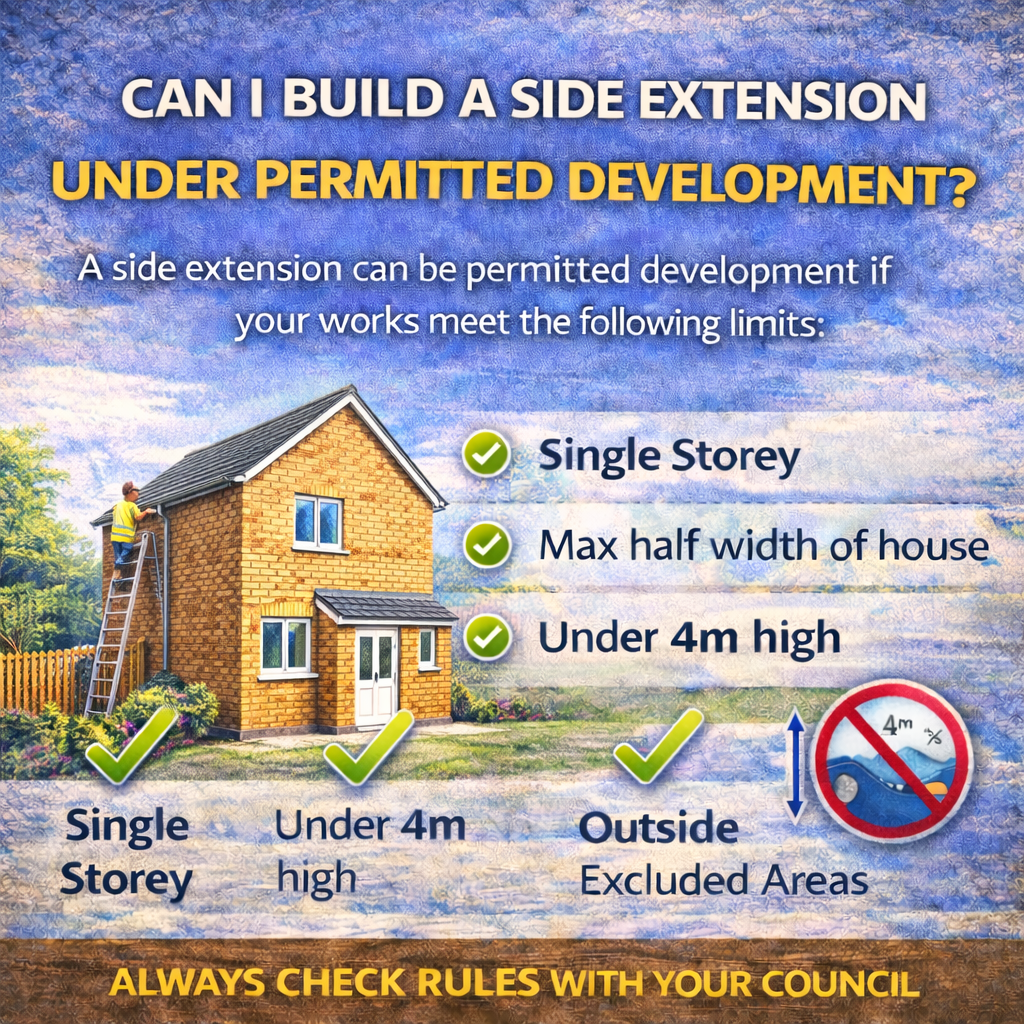
Permitted development rights exist to let homeowners make certain improvements without submitting a full planning application. These rights are defined under the Town and Country Planning (General Permitted Development) (England) Order 2015 (GPDO), which outlines the exact limitations for extensions, loft conversions, and outbuildings. Side extensions are treated cautiously compared to rear extensions because of their direct impact on street character and neighbouring properties. Councils are wary of ribbon development, where houses extend across plots and dominate the street, so a side extension under PD must meet strict size, height, location, and design limits. Misinterpreting these rules can lead to enforcement notices, retrospective applications, or costly redesigns.
The half-width rule is one of the most important limits for side extensions under PD. An extension cannot occupy more than fifty percent of the width of the original house. This ensures the addition remains subordinate to the property and does not visually overwhelm neighbouring homes. For example, a house measuring ten metres in width can generally only have a side extension up to five metres. Narrow homes or properties that have previously been extended may struggle to comply with this rule, often necessitating a full planning application. Corner plots or irregularly shaped plots can further complicate compliance, and councils may interpret coverage differently in these cases. Including a simple diagram showing half-width limits alongside property boundaries can help homeowners visualise the constraints and avoid mistakes.
Height is a crucial consideration under PD. Extensions with flat roofs must not exceed three metres, while dual-pitched or hipped roofs can rise to a maximum of four metres. Two-storey side extensions are generally excluded from PD, making planning permission necessary. Even when a proposed extension fits within these height limits, it must appear subordinate to the existing house. Extensions that appear overly tall or bulky, even if technically compliant, may draw objections from neighbours or the council. Proper integration with the roofline, eaves, and overall proportions of the house is essential to achieve a visually balanced and acceptable extension.
Not all homes benefit from unrestricted PD rights. Properties in conservation areas, national parks, Areas of Outstanding Natural Beauty, or near listed buildings may have reduced or removed PD allowances. Additionally, Article 2(3) land restrictions can prevent any extension in certain sites. Councils are strict in enforcing these rules to protect historic and sensitive areas. Even in unrestricted areas, previous extensions impact PD eligibility. Councils calculate cumulative coverage, assessing the total area of all extensions relative to the property’s curtilage. Ignoring these cumulative rules can result in refusal or enforcement notices, even if the new extension appears modest. Clear guidance from the Planning Portal or a professional review can help homeowners confirm eligibility before committing to design and construction.
Neighbours and the surrounding street scene are critical in side extension planning. Single-storey extensions positioned close to boundaries can block sunlight, reduce privacy, or feel overbearing, creating disputes even if the extension complies with PD rules. Councils assess whether an extension is unneighbourly, and objections can arise if it negatively affects adjacent properties. Street character is equally important. Extensions that clash with the rhythm, scale, or materials of surrounding homes may draw attention from planning officers. Early consultation with an architect or planning professional allows for design adjustments that respect neighbour amenity and the street scene, increasing the likelihood of a smooth project.
While PD removes the need for planning permission, it does not exempt a side extension from building regulations. Structural integrity, including foundations, steelwork, and roof joists, must meet safety standards. Fire safety, drainage, and energy efficiency are also required. Even modest extensions need to comply, and early consultation with a structural engineer or building control officer ensures compliance and avoids legal or safety issues. Materials play an equally important role. While PD does not restrict materials, extensions should complement the existing house to maintain cohesion and avoid a jarring appearance. Thoughtful use of matching brick, render, or roofing tiles preserves the property’s value and aesthetic.
Design strategy is essential to maximise space while staying within PD rules. Even with width and height limitations, clever layouts, natural light optimisation, and integrated storage can create highly functional interiors. Externally, aligning rooflines, recessing the front of the extension, or using landscaping to soften boundaries can help the addition appear integrated rather than intrusive. Strategic design differentiates a successful side extension from one that feels cramped, awkward, or out of place. Planning internal and external design together ensures that the extension enhances both usability and visual appeal.
Homeowners often make mistakes assuming PD is a free pass. Typical errors include exceeding the half-width limit, ignoring cumulative PD allowances, neglecting neighbour impact, or using materials that clash with the existing house. Councils actively enforce PD rules, and violations can lead to enforcement notices, retrospective applications, or expensive redesigns. Being aware of these risks and consulting professionals early can prevent costly mistakes.
Side extensions under PD are generally quicker and cheaper than full planning applications, but they still require careful planning and building regulations approval. A typical single-storey side extension may take eight to twelve weeks from design to approval for building regulations, with construction taking two to four months depending on complexity. Costs vary widely based on materials, size, and design, but a modest PD side extension often costs less than a full planning application project because fewer professional fees and application charges are involved.
Some situations necessitate a full planning application. Two-storey side extensions, properties in conservation areas or protected landscapes, or projects exceeding the half-width limit are outside PD. Submitting a planning application allows councils to review the project fully, reducing the risk of neighbour disputes or enforcement issues. Pre-application consultations highlight potential problems early, saving time, money, and redesigns. Even homeowners seeking PD benefits can gain clarity by understanding when full planning approval is a safer route.
A narrow Victorian terrace may only allow a 2.5-metre-wide single-storey extension under PD, making careful measurement and neighbour consultation essential. A corner plot in a conservation area may not be eligible for PD at all, requiring early council engagement. Detached modern homes with previous rear extensions might face cumulative coverage issues that push the project beyond PD eligibility. Thoughtful design, professional guidance, and compliance checks help navigate these challenges successfully.
Single-storey side extensions can be built under permitted development, but success depends on careful adherence to width, height, cumulative coverage, location restrictions, neighbour considerations, and building regulations. PD provides an opportunity for modest home expansion, but it is not a licence to ignore design, legal obligations, or context. A strategic, design-led approach maximises usable space, ensures safety, maintains neighbour harmony, and preserves property value. Early consultation with an architect or planning professional is highly recommended to achieve a legally compliant, functional, and attractive side extension.
By combining thorough understanding of PD rules, thoughtful design, and professional oversight, homeowners can create side extensions that work both practically and visually, turning PD rights into a real home improvement opportunity.
