
Summary
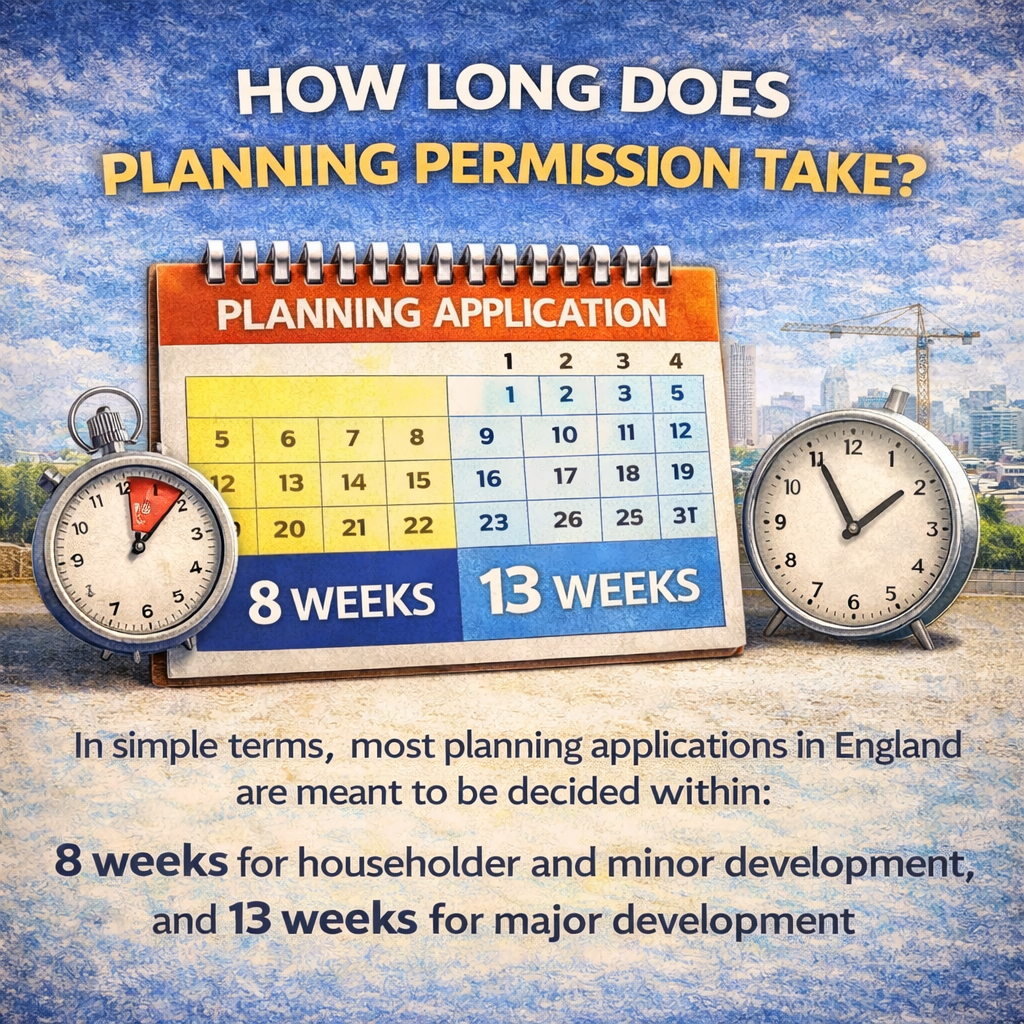
Most planning applications in England are meant to be decided within 8 weeks for householder and minor development, and 13 weeks for major development. In reality, how long planning permission takes is driven less by the statutory deadline and more by how much judgement, negotiation and risk the proposal introduces. If you treat planning as a fixed timetable, you will almost always be disappointed. Planning is discretionary, and time stretches wherever uncertainty exists.
People usually ask “how long does planning permission take?” once designs are finished and momentum has already built. By then, the answer is mostly out of their hands. The more useful question is: “What aspects of my proposal are likely to slow a decision down?” Applications move quickly when those issues are resolved before submission, not after.
Local planning authorities work to national targets:
Householder and minor development applications: 8 weeks
Major development applications: 13 weeks
These targets start only after validation. They are performance benchmarks, not guarantees, and they assume no unresolved issues arise during the assessment.
Validation is the council’s check that an application is complete and fit to assess. Poor-quality submissions often stall here. Unclear drawings, inconsistent dimensions, missing plans or incorrect descriptions can delay validation by weeks. This time is not counted in the statutory period, but it directly affects how long the process takes in practice. We always check the validation checklist of the local authority the application is being submitted to, to make sure we are submitting all the required drawings and reports and ensure we have no delays during the validation process.
Once validated, applications are consulted on, typically for 21 days. Neighbour comments and consultee responses do not automatically delay decisions, but they do require officers to assess whether any material planning issues are raised. If clarification or amendments are needed, the determination period inevitably extends. This is not a procedural failure; it is the system responding to unresolved impacts.
For a typical householder extension, the intended determination period is 8 weeks from validation, and many well-prepared extension applications are approved comfortably within this timeframe. Extensions are assessed primarily on how they relate to their surroundings – including neighbouring properties, the character of the area, and the existing home – which allows good design and clear thinking to work strongly in the applicant’s favour.
Straightforward rear extensions that are proportionate, respect separation distances and respond to local design guidance are commonly dealt with efficiently and without complication. Where proposals are slightly more ambitious – such as deeper layouts, two-storey elements or corner plot arrangements – the process often involves constructive dialogue with the planning officer to refine details, rather than fundamental objections. This collaborative approach is a normal part of the system and frequently results in stronger outcomes.
Extensions within conservation areas naturally receive closer design consideration, but this does not prevent approval. With the right level of care and context-led design, decisions are routinely reached within 8 to 13 weeks. In practice, planning works best for extensions when it is treated as a design conversation, not a barrier – and that is where positive, timely decisions are most often achieved.
Permitted development is often assumed to be faster, but this is not always the case. Applications for Lawful Development Certificates can still take up to 8 weeks, and any error carries enforcement risk. In many situations, a well-prepared planning application achieves a comparable timescale while allowing better design outcomes and greater certainty.
An Extension of Time is a formal agreement between the applicant and the local planning authority to extend the decision deadline beyond the statutory period. They are commonly used where an application is acceptable in principle but requires further assessment, clarification or limited amendments. In many cases, an Extension of Time indicates that officers are working towards a positive outcome rather than a refusal.
In many cases, if an applicant refuses an Extension of Time, the council may issue a refusal rather than allow the deadline to pass unresolved. This is often driven by performance requirements rather than the fundamental merits of the proposal. A refusal in these circumstances can require a new application, a further fee, and a complete restart of the process. In practice, refusing an Extension of Time frequently leads to longer delays than agreeing to a short, controlled extension.
Extensions of Time are not risk-free. We have dealt with applications where deadlines were extended repeatedly, creating prolonged uncertainty and frustration for clients. One recent example involved a new-build application for three dwellings on Green Belt / grey belt land, which took approximately one year from submission to decision. Successive Extensions of Time were agreed to allow issues to be worked through, but the cumulative effect was significant programme delay. This illustrates an important point: Extensions of Time should be purposeful and proportionate. Open-ended extensions without clear progress can materially affect viability and confidence.
A straightforward extension outside sensitive designations may be decided within 8 weeks. Schemes involving negotiation commonly take longer. Applications subject to repeated Extensions of Time can extend to many months. These outcomes are not anomalies; they reflect the degree of judgement required.
On paper: 8 to 13 weeks.
In practice: as long as it takes to resolve planning judgement properly.
Planning permission is not a stopwatch exercise. Time is shaped by clarity, design quality and strategy. Projects move fastest when uncertainty is dealt with before submission, not left for the planning officer to unravel. That is the difference between a smooth determination and months of avoidable delay.
