
Summary
Outline planning permission confirms whether development is acceptable in principle without approving the detailed design. It is most effective where the key uncertainty is policy-based rather than design-based. While it can unlock land value and reduce early expenditure, it does not grant permission to build and does not guarantee approval of later details. In many cases, the real planning risk simply moves to the reserved matters stage, where poorly thought-through outline strategies frequently unravel.
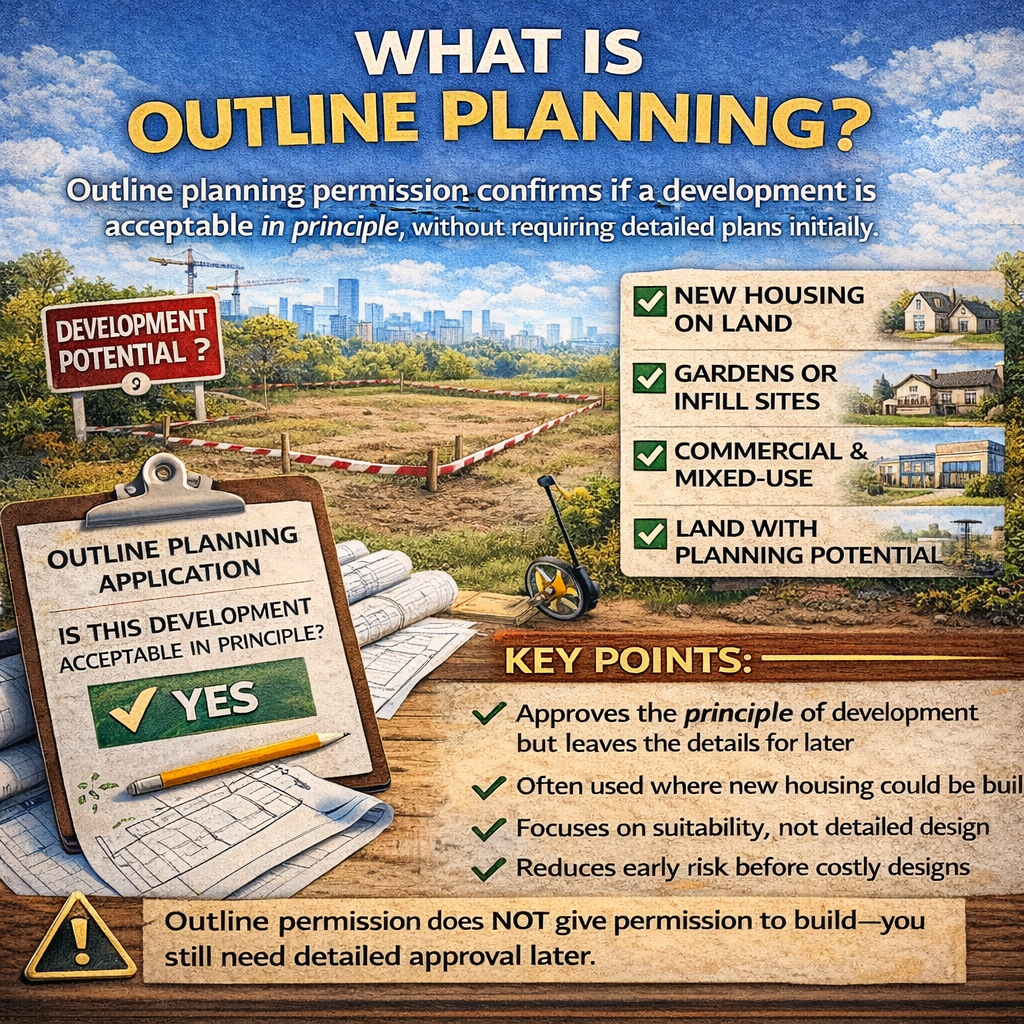
Outline planning permission is a form of planning consent that allows a local planning authority to determine whether the principle of development is acceptable on a particular site, without requiring full architectural, technical or landscape detail at the outset. In statutory terms, it sits alongside full planning permission within the Town and Country Planning framework. In practical terms, it is a risk-sequencing tool, not a lighter or easier consent. Outline planning permission answers one question only:
“Is development of this type acceptable on this site in principle?”
In real projects, outline planning permission is usually pursued for one (or more) of the following reasons:
The applicant wants to test whether land has development potential. The applicant wants to increase land value before sale.
The applicant wants to avoid spending heavily on design too early. The applicant wants flexibility for a future purchaser or later phase.
All of these are valid motivations. None of them make outline permission inherently safer. The critical question is not why outline permission is attractive – but what problem it is actually solving.
Is the planning risk on this site policy-based or design-based?
If the risk is policy-based – for example, whether a new dwelling is acceptable at all – outline planning permission may be appropriate.
If the risk is design-based – overlooking, massing, access, neighbour impact, character – outline permission rarely helps. It simply delays the point at which those issues must be resolved.
This distinction is almost entirely absent from the top three articles. It is also where most outline strategies fail.
At outline stage, the local planning authority considers high-level matters such as:
Whether the proposed land use accords with the development plan. Whether development is acceptable in principle on the site. Whether the amount of development proposed is broadly appropriate. Whether access can be achieved in principle.
Importantly, the authority is not agreeing that a workable, policy-compliant design exists – only that one might exist.
Outline permission confirms possibility, not deliverability.
This is a subtle but critical distinction that generic guidance rarely spells out.
One of the most misunderstood aspects of outline planning permission is how much detail is actually fixed.
An outline application can be submitted with:
“All matters reserved” means layout, scale, appearance, access and landscaping are all deferred.
Sometimes access is approved at outline stage to reduce risk. Occasionally scale is partially fixed. Appearance is almost always reserved. Each choice has consequences. Fixing access early can de-risk highways objections. Fixing scale too early can lock a site into unworkable parameters. These trade-offs are rarely explained in online articles, yet they determine whether reserved matters later succeed or fail.
When outline planning permission is granted, it is accompanied by conditions requiring approval of reserved matters before development can commence.
These typically include:
Layout
Scale
Appearance
Access
Landscaping
Each reserved matters submission is a full planning application in its own right. Reserved matters are not a formality. They are assessed against the same policies as a full planning application. Officers reassess impact. Neighbours object again. Consultees revisit access, drainage, ecology and amenity. Outline permission does not weaken these tests. It merely postpones them.
We were approached by a homeowner with an unusually large rear garden who wanted to understand whether part of the land could accommodate a new dwelling for sale. A full planning application would have required committing to a specific design before the key issue – acceptability of a garden dwelling – had been resolved.
Following an initial feasibility assessment, we advised an outline planning application with all matters reserved. This allowed the local planning authority to focus solely on whether a new dwelling was acceptable in principle, without premature debate about layout, scale or appearance. The outline planning application for one self-build dwelling was approved. However, the decision notice included a condition stating that, before development commenced, approval must be obtained for the reserved matters – namely layout, scale, appearance, access and landscaping. Landscaping was also required to be implemented in accordance with an approved scheme prior to occupation or as otherwise agreed. The outline consent unlocked land value and planning potential. It did not grant permission to build.
Outline planning permission is most effective where uncertainty is genuinely policy-led, such as:
Large gardens or side land
Edge-of-settlement sites
Land with unclear planning status
Sites being prepared for sale
Long-term or phased development opportunities
In these situations, outline permission tests the right question at the right time.
Outline planning permission does not bind a council to approve future details.
It does not reduce neighbour influence.
It does not soften design policy.
It does not guarantee buildability.
In some cases, officers scrutinise reserved matters more carefully because the principle has already been conceded. Poor outline strategy leads to redesign costs, delay, aborted schemes and land that is technically approved but commercially unusable.
Outline planning permission works when it is used intentionally, not defensively.
Access is often worth resolving early.
Broad scale sometimes is.
Appearance almost never is.
Where outline permission fails, it is usually because it was used to avoid difficult decisions rather than sequence them intelligently.
Outline planning permission is not a shortcut, a guarantee, or a diluted approval. It is a strategic mechanism for testing acceptability in principle while deferring detail. Used correctly, it can unlock opportunity, manage risk and create value. Used incorrectly, it can delay progress and undermine otherwise viable projects. The real expertise lies not in knowing the definition – but in knowing when outline planning permission genuinely serves your interests, and when it simply moves the problem further down the line. That judgement is what separates successful planning outcomes from those that stall despite having “permission” on paper.
