
Summary
Planning permission and permitted development are not interchangeable shortcuts. Planning permission resolves uncertainty before building begins through professional judgement. Permitted development is a strict legal allowance that only works when its limits are met exactly. Most problems arise when homeowners treat permitted development as the easier or safer option, when in reality it often carries greater long-term risk.
Most articles comparing planning permission and permitted development focus on definitions. They explain what each route is, but they rarely explain how those routes behave in real projects, where homeowners actually get caught out, or why choosing the wrong one can quietly create legal, financial and practical problems later.
This article is written from the perspective of practice, not policy. It explains how experienced professionals think about this decision, where risk genuinely sits, and how to choose the right route before designs are fixed or money is committed.
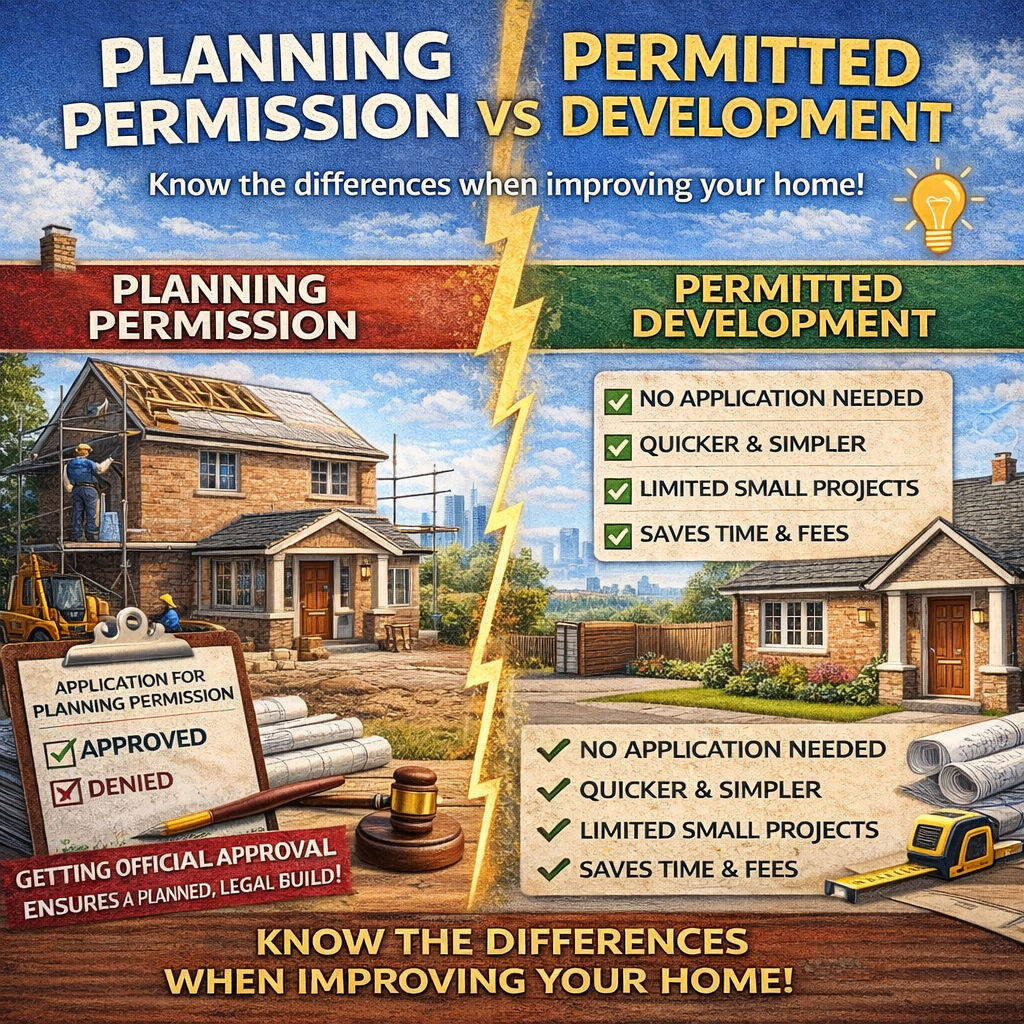
Planning permission and permitted development exist to solve different planning problems. Planning permission is used where judgement is required. The council assesses scale, massing, design quality, neighbour impact, character and policy compliance together. There is room for discussion, professional judgement and refinement of proposals.
Permitted development removes that judgement entirely. It allows very specific forms of development where impact is already considered acceptable in principle, but only if strict national rules are met in full. There is no discretion, no negotiation and no balancing exercise. Understanding this distinction is fundamental to understanding why these two routes behave so differently in practice.
With planning permission, risk is resolved upfront. Once permission is granted, the principle of development is established. Provided the works are built in accordance with the approval, the risk of later challenge or enforcement is very low. With permitted development, there is no advance approval. The homeowner proceeds on the assumption that the rules have been complied with. If that interpretation is later challenged, often following a neighbour complaint or solicitor query, the burden of proof sits entirely with the homeowner. This is why permitted development often feels simpler at the beginning but more stressful later, while planning permission feels more involved initially but calmer once work starts.
Permitted development is frequently framed as a way to avoid planning permission. That mindset causes more problems than it solves. The real objective should not be avoidance, but certainty. Forcing a proposal into permitted development simply because it might be arguable often creates long-term exposure, particularly with wrap-around extensions, dormers, or properties in conservation areas. Permitted development only works well when a proposal sits comfortably within the rules, not when it is pushed to their limits.
Porches can often be built without planning permission, but only where the external footprint does not exceed three square metres, the overall height does not exceed three metres, no part of the porch sits within two metres of a boundary or the highway, and the original front door remains in place. Porches frequently fall outside permitted development where properties sit close to pavements or where designs become too enclosed and read as extensions rather than modest additions.
Single-storey rear extensions are another common area of misunderstanding. Detached houses are generally limited to four metres from the original rear wall, while semi-detached and terraced houses are limited to three metres. Overall height must not exceed four metres, and where the extension sits close to a boundary, eaves height is restricted to three metres.
The total area covered by extensions and outbuildings must not exceed fifty percent of the original garden area, taking into account all previous works. These limits are measured from the original house as it stood in 1948 or when first built, which often surprises homeowners who assume more recent alterations do not count.
One of the most persistent misconceptions is that a wrap-around extension can be achieved by combining a compliant rear extension with a compliant side extension. Permitted development does not allow this. Once rear and side extensions are physically linked into a single continuous form, the resulting scale and mass go beyond what permitted development is intended to allow. At that point, full planning permission is required regardless of individual dimensions. This is one of the most common causes of retrospective applications and enforcement action we encounter.
Dormer extensions are where misunderstandings between planning permission and permitted development cause the most damage. Permitted development allows roof extensions only within strict volume limits. Terraced houses are limited to forty cubic metres of additional roof volume, while detached and semi-detached houses are limited to fifty cubic metres. This volume includes all roof additions, not just the visible dormer.
Homeowners frequently miscalculate volume or assume that appearance is the deciding factor. In practice, a dormer can look modest but still exceed permitted development limits on paper. Dormers must also be set back from the eaves, must not extend above the highest part of the roof, and must not be located on the principal elevation facing the highway.
Conservation areas are where generic permitted development advice breaks down. Permitted development rights are often reduced or removed, meaning works that would be lawful elsewhere may require full planning permission regardless of scale. Online guidance rarely reflects this nuance. Planning permission allows heritage impact and design quality to be assessed directly. Permitted development does not adapt to context, which is why professional advice is particularly important for conservation area properties.
Permitted development is safer only when a proposal sits clearly and comfortably within the rules and confirmation is obtained. Where interpretation is required, planning permission is often the safer option because uncertainty is resolved before work begins.
In practice, experienced professionals do not start by asking whether something can be done under permitted development. They assess how close a proposal is to the limits, what the planning history reveals, whether the site is sensitive, and what happens if the interpretation is challenged later. If those answers point to risk, planning permission is usually the correct route, even where permitted development might be arguable.
We assess the property, its planning history, its location and the proposal itself before advising which route offers the greatest certainty. Where permitted development genuinely applies, we confirm it properly. Where planning permission is safer, we explain why and design accordingly. Permitted development only works when you are comfortably within the rules, not when you are trying to make them fit.
If you are unsure whether your proposal is better suited to permitted development or planning permission, that decision is worth resolving early. A short conversation can usually clarify where risk sits and which route gives you confidence before anything is built. You are welcome to book a call to talk it through.
